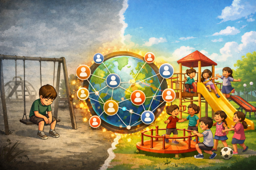
Mental Health Awareness Month, observed every May, has evolved from a symbolic campaign into a structural public health movement. Established in 1949, it now serves as a global platform to normalise conversations, reduce stigma, and expand access to care. (Wikipedia)
In 2026, the discourse has shifted. Awareness alone is no longer sufficient. The emphasis is on measurable well-being, community integration, and actionable change.
Theme of 2026: “More Good Days, Together”
The official 2026 theme, “More Good Days, Together,” reframes mental health from crisis response to daily experience optimisation. (Mental Health America)
This theme operates on two levels:
Individual level: What defines a “good day”? Emotional stability, productivity, meaningful connection.
Collective level: How systems (family, workplace, policy) enable or obstruct those good days.
The framing is subtle but important. It shifts the narrative from illness to quality of lived experience.
Why Mental Health Awareness Still Matters
Mental health is not an abstract concept. It directly governs cognition, emotion, and behaviour, shaping how individuals function in society. (MedlinePlus)
Despite progress, structural gaps remain:
Stigma continues to suppress help-seeking behaviour
Access to care is uneven and often expensive
Early intervention is still underutilised
Awareness campaigns exist because these failures persist. Without them, mental health retreats back into silence.
Core Objectives of the 2026 Campaign
1. Normalise Conversation
Silence amplifies stigma. Campaigns in 2026 explicitly push storytelling and shared narratives to humanize mental health struggles. (NAMI)
2. Promote Early Intervention
Most mental conditions emerge early in life, yet treatment is delayed. Awareness aims to shorten that gap. (National Council for Mental Wellbeing)
3. Build Community-Centred Support
The 2026 theme emphasises that mental health is not an individual battle. It is socially embedded.
4. Improve Access to Resources
Campaigns highlight helplines, therapy options, and digital tools to reduce friction in seeking help.
Emerging Themes in 2026
A. From Awareness to Action
Earlier campaigns focused on education. Now the emphasis is behavioural:
Seeking therapy
Practicing self-regulation
Supporting others
Awareness without action is performative. 2026 explicitly rejects that.
B. Community as Infrastructure
Mental health is increasingly seen as a network effect.
Isolation correlates with distress, while connection improves resilience.
This aligns with the broader idea that well-being is co-produced, not self-generated.
C. Everyday Mental Health
The “good day” concept introduces a micro-level lens:
Sleep quality
Social interaction
Work stress
Digital consumption
Mental health is no longer framed only in extremes like depression or anxiety, but in daily fluctuations.
D. Integration with Physical Health
Global health discourse now treats mental health as inseparable from overall health.
A functional individual must be both physically and mentally stable. (CDC)
Critical Perspective: Where the Movement Falls Short
This needs a blunt assessment.
Corporate appropriation
Many organisations adopt mental health messaging without structural change. Awareness becomes branding.Access inequality
Campaigns speak loudly, but services remain inaccessible for many, especially in developing regions.Over-individualization
Too much focus on self-care ignores systemic stressors like unemployment, academic pressure, and social instability.Digital superficiality
Social media activism often reduces complex issues to slogans. That dilutes seriousness.
Practical Ways to Engage in 2026
Reflect on what constitutes a “good day” in measurable terms
Build at least one meaningful social connection
Reduce stigma by speaking openly
Use verified mental health resources
Advocate for institutional change, not just personal coping
Philosophical Undercurrent
Mental health awareness in 2026 raises a deeper question:
Is well-being an individual responsibility or a collective design problem?
The answer is uncomfortable. It is both.
But current systems often shift the burden unfairly onto individuals.
Mental Health Awareness Month 2026 is not about sympathy.
It is about redesigning how humans live, work, and relate.
“More Good Days, Together” is less a slogan and more a metric.
If people are not actually experiencing better days, the movement is failing.